Published August 24, 2026
Tiny Chefs is the part of our program parents ask about most, usually because their child came home talking about it. It is a guided cooking activity for three-to-five-year-olds that runs regularly through the year as part of the ordinary day, at no extra charge. This article explains what a session looks like, which skills each step is quietly teaching, how we keep it safe, and three recipes you can do at home this weekend.
What a session looks like
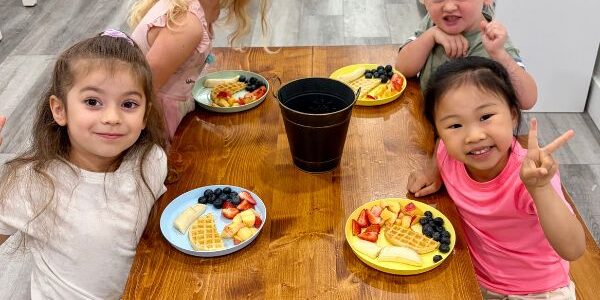
A Tiny Chefs session happens at the children’s tables in our regular room, in small groups with an educator, so every child gets their hands in. It starts with hand washing and a look at the ingredients: what they are, where they come from, what they smell like. The educator walks through the recipe one step at a time. Children do the measuring, pouring, stirring, spreading and assembling themselves; the adult’s job is to guide, not to do. When the food is safe and appropriate, children taste what they made, in small portions.
Recipes are deliberately simple and mostly no-cook or low-heat, the sort of thing a three-year-old can do most of: a fruit salad, a yogurt parfait, a spread on crackers, a batter mixed by hand and baked by an educator. The aim is participation, not a finished dish.
What each step is teaching
| What the child does | What it builds |
|---|---|
| Counts out six berries, measures one cup of oats | One-to-one counting, quantity, early math with a purpose |
| Follows the recipe: “first, then, next” | Sequencing and listening to multi-step instructions, which kindergarten teachers value more than letter recognition |
| Pours, stirs, spreads, tears lettuce, uses a child-safe knife on a banana | Fine-motor control and hand strength, the same muscles used for holding a pencil |
| Waits for the bowl, passes the spoon | Turn-taking and cooperation in a small group |
| Smells, touches and tastes a new ingredient | Food exploration without pressure; the group makes new foods less strange |
| Wipes the table and washes the bowl | Finishing a job, and the ordinary pride of having made something |
None of this is presented to the children as a lesson. It is presented as cooking, which is why it works.
How we keep it safe
- Allergies first. Families list every allergy and dietary restriction at registration, and every session is planned around what is currently in the room, following the centre’s allergy, dietary and food-safety policies.
- Choking-aware ingredients. Soft fruit cut small, no whole grapes, no nuts, no popcorn, no hard candy. The same rules we ask families to follow for packed lunches.
- Heat stays with the adult. Children mix and assemble; educators handle anything hot.
- Hand washing before and after, every time, which is also why Tiny Chefs is a useful hygiene lesson in disguise.
Three recipes to try at home
Children love repeating what they did at daycare, and the skills transfer. Each of these takes about fifteen minutes with a three-year-old doing most of the work.
Yogurt parfait
Give your child a clear cup, a small bowl of plain or vanilla yogurt, a bowl of soft berries cut in half, and a bowl of oats or crushed cereal. They spoon a layer of each, in order, and count the layers. Job for the child: everything. Job for you: keep the bowls topped up.
Banana sushi
Peel a banana. Your child spreads a thin layer of sunflower-seed butter (or cream cheese) along it with a butter knife, rolls it in crushed cereal, and cuts it into coins with a child-safe knife. Cut the coins in half again for a younger three-year-old. Job for the child: spreading, rolling, cutting. Job for you: the peel and the plate.
Rainbow fruit skewers, without the skewer
Skip the sharp stick. Give your child a plate and small bowls of soft fruit already cut small: strawberry halves, banana slices, orange segments cut in two, blueberries halved for under-fours. They arrange a rainbow in order and name the colours. Job for the child: sorting and arranging. Job for you: cutting.
What Tiny Chefs is not
It is not a separate class, it does not replace the 9:00 to 10:30 preschool block, and it is not a “culinary program” in any grand sense. It is a regular, guided activity inside an ordinary day of care, chosen because a child who has measured, poured and stirred something themselves carries a particular kind of confidence, and that confidence tends to travel well beyond the kitchen.
Related: Tiny Chefs Program · Packing lunches and snacks for daycare