Published July 21, 2026
“Montessori-inspired” is on a lot of daycare websites, including ours, and it can mean almost anything. This article explains what the phrase should mean, how a Montessori-inspired room differs from a traditional daycare room at five specific moments in the day, and what we do and do not do, so you can judge the claim rather than take it on trust.
First, the honest definitions
Montessori is a specific method with its own teacher training and accrediting bodies (AMI and AMS are the two best known). A school that calls itself a Montessori school without qualification should have trained Montessori guides and a full set of Montessori materials.
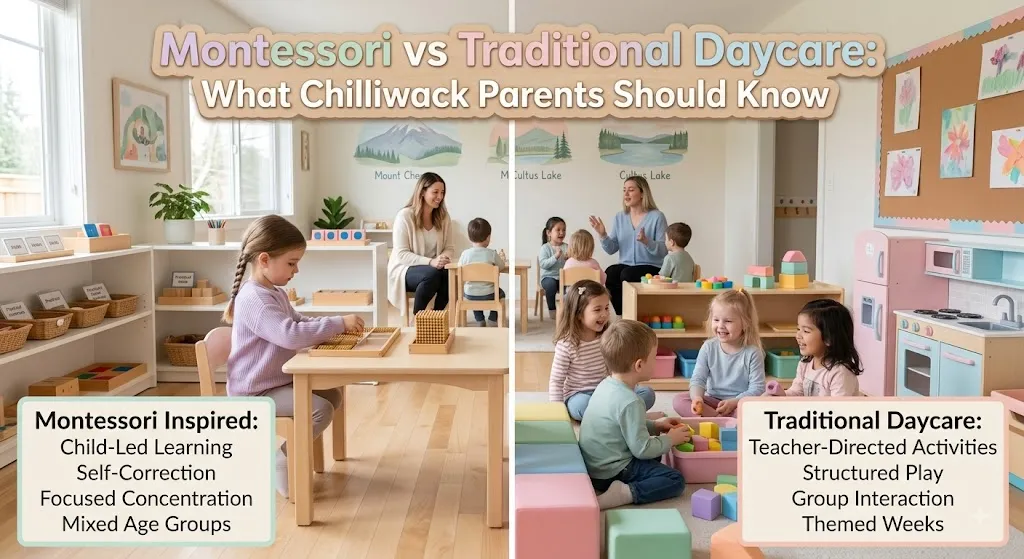
Montessori-inspired means a program borrows principles from Montessori, usually independence, self-chosen work, prepared materials at child height and long stretches of uninterrupted concentration, without claiming accreditation or following the method to the letter. That is what we are. We also draw on Reggio Emilia, which treats children’s own questions as the starting point for projects, and on nature-based learning.
Traditional daycare is not a method at all. It usually means an adult-led program: circle time, a craft, free play, snack, with the day organised around the group rather than around each child’s choices.
Neither label tells you about quality. In BC every centre, whatever its philosophy, is licensed to the same health, safety and staffing standards under the Child Care Licensing Regulation. Philosophy changes what the day feels like, not whether it is safe.
Five moments where the difference shows
1. Arrival
Traditional: children arrive, hang up coats with help, and join whatever the group is doing.
Montessori-inspired: children hang up their own coat on a hook at their height, change their own shoes, and choose their first activity from open shelves. The first ten minutes of the day are already practice in independence.
2. The learning block
Traditional: the educator leads an activity for the whole group at the same time, often with a worksheet or a craft that everyone completes the same way.
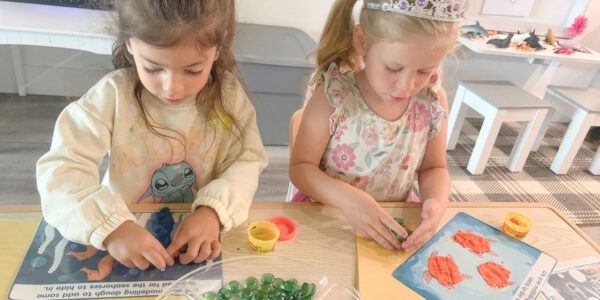
Montessori-inspired: the educator opens the block with a short circle (a song, the calendar, a story), then children move to hands-on work at tables and on mats: counting real objects, pouring and transferring, matching letters to sounds, sensory bins, art. The educator moves between children rather than standing in front of them. There are no worksheets and nothing is drilled.
3. Snack
Traditional: snack is served and cleared by adults.
Montessori-inspired: children open their own containers, pour their own water, sit family-style and clear their own place. It takes longer. That is the point.
4. A disagreement over a toy
Traditional: an adult resolves it, often by removing the toy or setting a timer.
Montessori-inspired (and Reggio-influenced): the educator names the feeling, helps each child say what they want, and lets them try a solution first. Learning to wait, to share, and to recover from a big feeling is treated as curriculum, not as an interruption to it.
5. Tidy-up
Traditional: adults tidy at the end of the day, or the whole group tidies on command.
Montessori-inspired: each material has one place on the shelf, and returning it is part of finishing the work. Children tidy as they go, which is why the room can stay calm with sixteen children in it.
What “blended” means in practice
A room that follows one method to the letter asks every child to fit the method. We take the opposite view: pull the best tool from each tradition for the child in front of you. From Montessori we take the prepared environment and independence. From Reggio Emilia we take projects that start from children’s questions and a heavy emphasis on art and self-expression. From nature-based learning we take two outdoor blocks a day, in all weather that is safe. Educators plan the week with clear intent and then adjust to the group actually in the room.
What we do not do
- We do not claim Montessori accreditation, and our educators are certified Early Childhood Educators rather than Montessori-trained guides.
- We do not run a full three-hour Montessori work cycle. Our structured block is 9:00 to 10:30, inside a full day of care.
- We do not separate ages. Three-, four- and five-year-olds share one room and one group of up to sixteen, which is closer to Montessori’s mixed-age approach than to a traditional age-banded centre.
- We do not use worksheets or forced drills. Early literacy and math are built through sounds, stories, counting and hands-on materials.
Questions that cut through the label
- Can I see the shelves? Are materials at child height, and can children choose and return them without asking?
- During the learning block, is the educator in front of the group or moving between children?
- How do children handle snack, coats and tidy-up: themselves, or with adults doing it for them?
- What happens when two children want the same thing?
- If you say “Montessori-inspired”, what specifically do you take from Montessori, and what do you leave out?
Any centre, ours included, should be able to answer all five in plain language. If you would like to see the answers rather than read them, tours run after 2:30 p.m., once the morning block is finished and the room is in its afternoon rhythm.
Related: Our learning approach · How the preschool block fits inside full-day care