Published July 4, 2026
Many Chilliwack families end up running two programs for one child: a part-day preschool for the learning, and a daycare for the hours. Two drop-offs, two sets of educators, two sets of rules. This article explains the alternative we run, a preschool block built inside a full day of care, and why keeping the whole centre at sixteen children is what makes it work. It also sets out the trade-offs, because there are some.
The problem with two programs
A licensed preschool in BC is a part-day program: a few hours, a few days a week, with children at least 30 months old on entry. It is designed for a family with an adult at home the rest of the day. Working parents who want that kind of structured early learning often bolt it onto a separate daycare, and the child spends the morning being moved between buildings and adults. For a three-year-old, the moving is the hard part.
Where the block sits in the day
Our answer is to run the preschool block as one segment of the full day, in the same room, with the same educators. The shape is the same every day:
| Time | What happens |
|---|---|
| 7:30 to 8:45 | Arrival, indoor and outdoor free play |
| 8:45 | Tidy-up, toileting, handwashing |
| 9:00 to 10:30 | Preschool learning block |
| 10:30 | Snack from home, family-style |
| 11:00 to 12:00 | Outdoor play or nature walk |
| 12:15 to 12:45 | Lunch from home |
| 12:45 to 2:15 | Rest and quiet time |
| 2:30 | Music and movement circle |
| 3:00 to 5:30 | Snack, outdoor or indoor play, wind-down, pickup |
A child who arrives at 7:30 plays, then simply moves into the block at 9:00 with the adults who greeted them. There is no separate drop-off, no separate room and no switching of educators. The full schedule is on our daily schedule page.
What the block actually contains
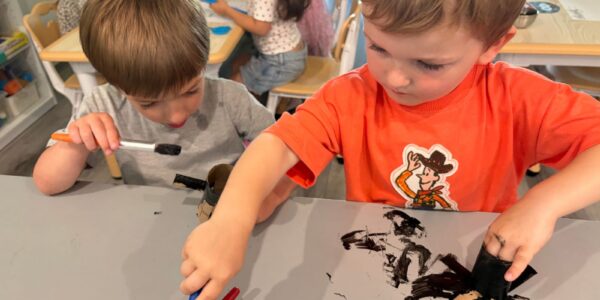
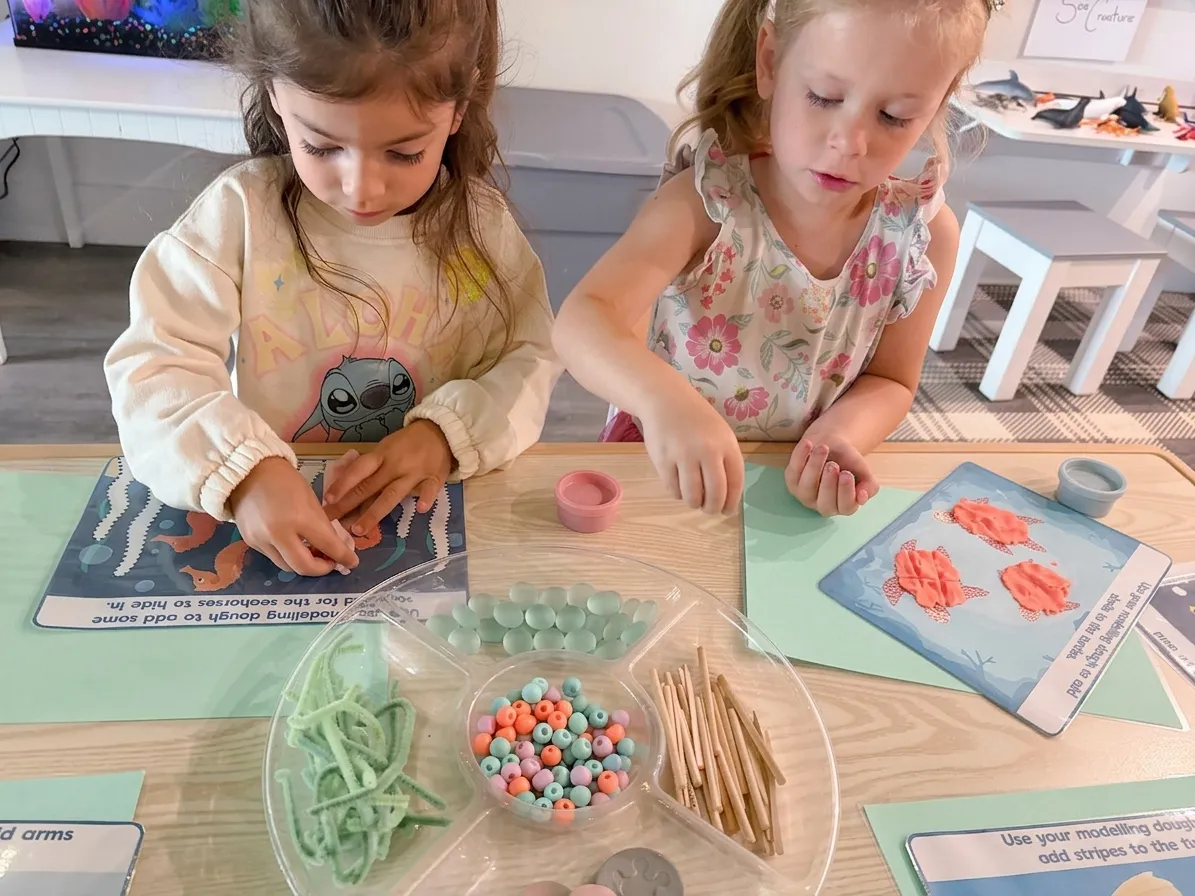
Ninety minutes is long enough to do real work and short enough that three-year-olds stay with it. A typical block opens with a learning circle: a song, the calendar, a story, and a turn for each child to be heard. The group then moves to hands-on work: early literacy (sounds, rhymes, mark-making, matching letters to sounds), early math (counting real objects, patterns, comparing sizes and quantities), fine-motor work (scissors, threading, pouring), sensory activities and creative art. Educators plan the week with specific goals and adjust to the children in front of them. Nothing is a worksheet.
Because the block ends at 10:30, the rest of the day is not “aftercare” with the learning switched off. Snack, outdoor play, lunch and tidy-up are where the independence practised in the block gets used.
Why the whole centre stays at sixteen
Sixteen is our licensed capacity, set by Fraser Health for our space, and we keep enrolment there rather than treating it as a target to grow past. Here is what the number changes in practice:
- Two educators, one group. The regulation for ages 30 months to school age is one educator per eight children, so a full group of sixteen means two educators in the room. The same small team runs arrival, the block, lunch and pickup.
- The educator can actually notice. In a group of sixteen, the child who is quieter than usual, or who is struggling with a task, gets seen and the morning gets adjusted. In a room of forty, the plan tends to run the children.
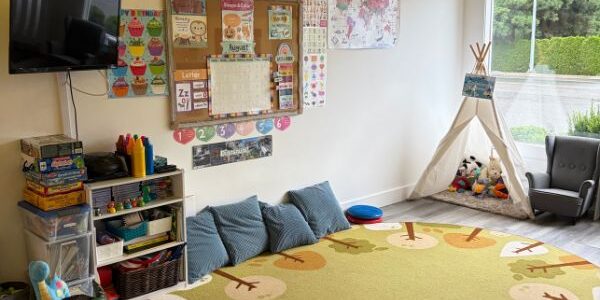
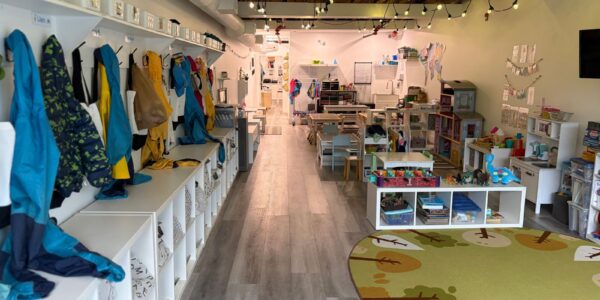
- Routines hold. Family-style snack, self-serve shelves and children tidying their own work are only realistic when the group is small enough for the adults to coach rather than manage.
- Consistency is structural, not a promise. With one group and one team there is no rotation between rooms as a child ages. The adult who taught your child’s letters is the one at the door at 5:15.
The trade-offs, stated plainly
- Ages 3 to 5 only. We do not offer infant or toddler care, and we do not offer before- or after-school care. A family with a one-year-old and a four-year-old will need two arrangements.
- One mixed-age group. Three-, four- and five-year-olds share the room. Most children benefit from it; a family that wants strict age-banding will prefer a larger centre.
- Sixteen spaces fill. A small centre has a short list of openings. Registration is first come, first served, and we tell you honestly where you stand.
- The block is 90 minutes. If you want a three-hour academic preschool morning, this is not that.
Questions parents ask
Is the preschool block extra? No. It is included in full-day care at no separate charge.
Can my child attend the block only? Our licence is for full-day group care and the block is part of it; contact us to talk through part-time days.
Will the same educators be there every day? Yes. One group, one team.
Can I see the block running? Tours run after 2:30 p.m. so the morning is not interrupted; you will see the room set up for it and can ask the educators anything about it. Book a tour.
Related: Morning Preschool Program · Full-Day Care · Montessori-inspired vs traditional daycare